Common Questions
Academics
-
The Liberal Arts are separated into two parts: the Trivium and the Quadrivium. The Trivium consists of Grammar, Logic, and Rhetoric: the linguistic approach to knowledge. The Quadrivium consists of Arithmetic, Geometry, Music (Harmonia), and Astronomy (Cosmology): the numerical approach to knowledge. Traditionally, the seven liberal arts were understood to be the essential buildings blocks of all education, for they equipped the mind to understand the Word and the World. As Scripture says, “it is the glory of God to conceal a matter” (Prov. 25:2). The liberal arts equip students to search out the hidden truths of God’s Word and God’s World in order to better know, love, and serve the Lord. See our Program of Study for more.
-
God speaks directly to us through his infallible Word; but His wisdom can also be discerned in the writings and traditions of the past. The classical approach to education is founded on the conviction that the treasures of God’s wisdom are contained in books that have been written and preserved throughout time. While most modern education assumes that newer is better, we believe that time is the great sifter: separating timeless wisdom from fleeting fads and passing fancy. This does not mean that an older text is necessarily better or wiser than a newer text simply because of its age—but in humility we recognize that if many people from different times and cultures have recognized the wisdom of a work as to ensure its survival, then it is more likely to speak to truths that are both timely and timeless. We are committed to letting the great texts of the past speak to us in the present so that we might gain the wisdom of our forebears and press on toward greater knowledge and insight.
-
Because of our small student body all our students are known and loved. Unlike most colleges today, NCF forms the whole person — our students learn that a life well lived goes beyond your career. We also are one of the only colleges in America that provides a full classical christian liberal arts education as it was done historically.
-
The liberal or “free” arts educates the whole person and prepares students to be free thinkers. Unlike modern education, which is designed to create cogs in a machine, a liberal arts education teaches students how to think, not what to think. Because of this broad application, students graduating with a Bachelors in the Liberal Arts are equipped to enter whatever field they choose.
-
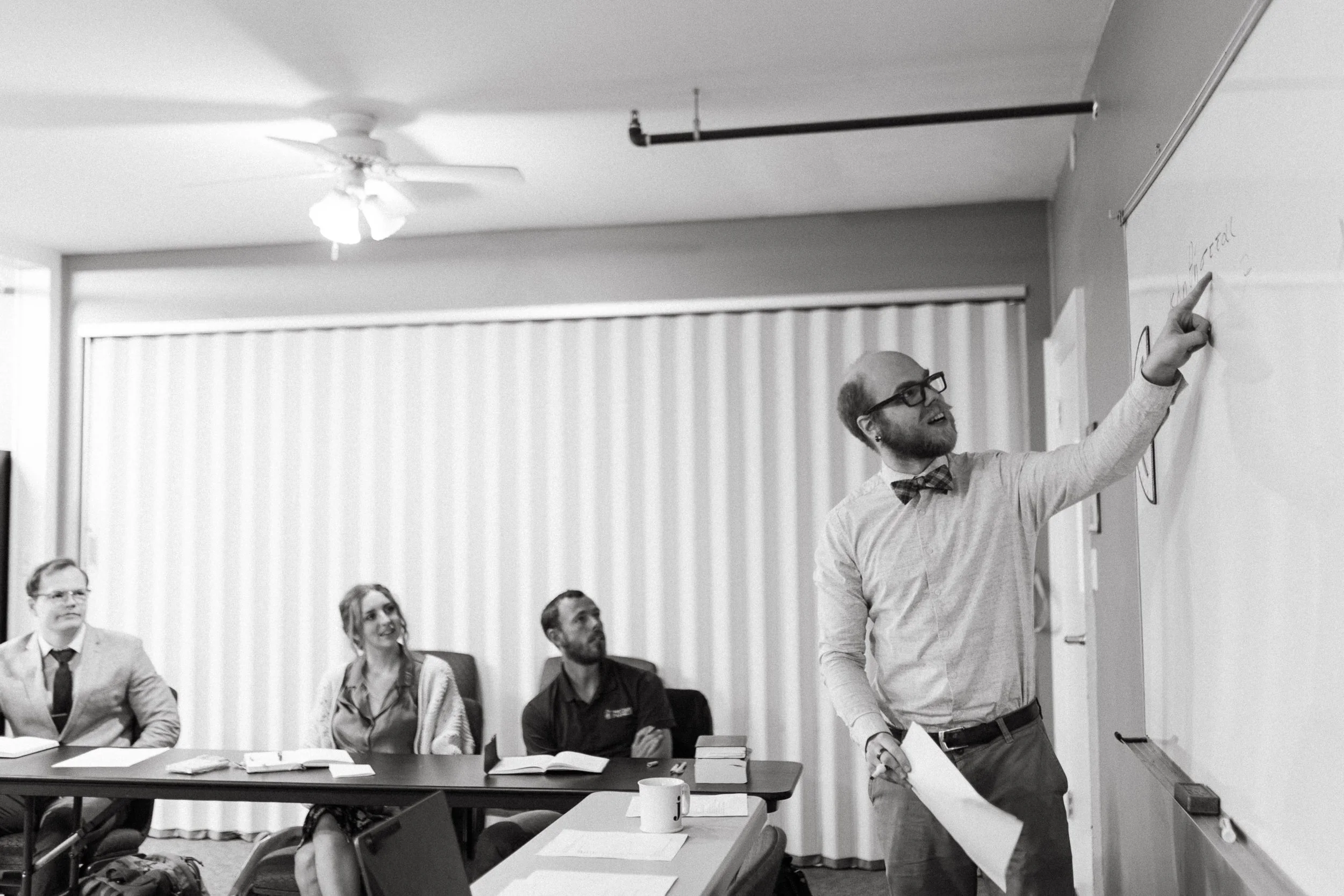
Rather than lectures in auditoriums from TA’s who don’t know your name, classes at NCF are intentional conversations around a table about great texts and great conversations, led by one of our Fellows. Class sizes are limited to about 15 students, which means that professors know every student and students all know each other, allowing for deep conversation, mentorship, and discipleship.
-
Yes, we are accredited. New College Franklin is a member of the Transnational Association of Christian Colleges and Schools (TRACS).
-
New College Franklin offers need-based scholarships to its students, paid for by generous donations by friends of the institution. We are also eager to consider accepting scholarships from external private funds including, but certainly not limited to the Classic Learning Test, church scholarships, and other private and secular sources.
We are committed to our mission and will not knowingly accept funds that would jeopardize our ability to fulfill what God has called us to do. Therefore, NCF does not and has no plans to accept Federal Student Aid, the GI Bill, or any other federal or state funding that would come with potential requirements for the institution.
-
Unlike the majority of U.S. colleges, we believe that students' money should be going toward their education, rather than to support an oversized administration. Because of that, we keep our operational and administrative costs to a minimum and direct the majority of student tuition into the classroom. Additionally, we rely on our generous donors to cover the rest of our operational costs so that we can keep tuition affordable for every student. Our tuition is about a third of the average private college tuition. In addition to being one of the most affordable private colleges in the nation, we offer generous merit and need-based scholarships.
Student Life
-
Almost every New College student enjoys reading. Students like to consider and share challenging ideas and work hard to dig deep into difficult questions and texts. They are willing to read broadly and deeply. They tend to be musical and enjoy creative endeavors as well as active service in the church. They’re willing to work hard and have an adventurous spirit. The average CLT score of our student body is an 87, which is in the 90th percentile nationally.
-
Our students hail from all over the United States and Canada. Many of our students graduated from a formal school setting while the majority come from homeschool settings. The student body is divided fairly evenly between men and women. Students come from many different theological traditions and denominations, including Presbyterian, Anglican, Greek Orthodox, Baptist, Non-Denominational, and many others. We welcome any Christian student who adheres to the historic creeds of the Christian faith.
-
Rather than living in impersonal dorms, we desire our students to live in the community, growing into the responsibility of taking care of their space, learning to live with others, and maintaining a home.
Our out-of-town students live mostly in apartments rented with other students or in host homes with families from the community. The New College office connects students with roommates when needed and is able to recommend host families or provide students with a list of local apartments.
See more on our Student Residence page.
-
Many of our students work throughout their time at New College. In addition to meeting the financial needs of the student, employment during college provides the opportunity to develop a work history prior to graduation. We typically create the class schedule with uninterrupted blocks of time for students to use for employment. However, when possible, we encourage first-year students to think carefully before adding employment to their New College schedule and recommend that students work no more than 10 hours a week.
-
Absolutely! Our students have been accepted at many different colleges, universities, and seminaries pursuing master’s and doctoral studies in many disciplines. Some of our students have gone on to law school and medical school as well. We are committed to ensuring our students have a path to further their education in whatever field they desire, and many of our students have received recognition for scholarly excellence in their graduate studies.
Our graduates have been accepted into University of Aberdeen, University of Dallas, Washington University, Westminster Theological Seminary, Puritan Reformed Theological Seminary, Trinity Evangelical Divinity School, Beeson Divinity School, Reformed Theological Seminary, Medical University of South Carolina, Calvin Theological Seminary, University of Dallas, Gordon-Conwell Theological Seminary, the Davenant Institute, and University of Nebraska.
-
This question strikes at the heart of true education. The short answer is that the Christian liberal arts will prepare students not simply for a job, but for life: every day from the time they wake up to the time they go to bed. This includes helping students prepare for working in the world, in the church, and in the home. Our students have never failed to find meaningful work after graduation, but we aren’t primarily concerned with students entering a specific field, as much as ensuring that they are prepared throughout life to engage in any field to the glory of God and service of all people.
For a more detailed discussion of our philosophy of vocation, click here.